Katie thought up this delicious twist on Matt's bread recipe and recommended it to me. Today I tried it and just the smell of it baking made me think of Spain for some reason. The flavor is awesome.
Showing posts with label Bread. Show all posts
Saturday, January 29, 2011
Saturday, January 15, 2011
Bread Making Trial 5
See the previous experiments here:
Break Making Experiment 3
Bread Making Experiment 4
The result of experiment 4 was a bread loaf that was chewy and had a good flavor, but was too small. I went out to shop for flour and noticed that Lehi Roller Mills Artesian Bread flour was on sale at the Harmon's case lot sale so I bought 16 pounds.
For experiment 5, I followed the recipe for basic white bread on the Lehi Roller Mill's bag which is essentially what I had arrived at in experiment 4, except it didn't use a pooling (or preferment) and it included sugar. I use a pooling because in my experience it makes bread have a more complex flavor and chewy texture, it saves yeast, and all the good bread bakers seem to do it.
Lehi Roller Mills basic white bread recipe, adapted to use a pooling
1 1/8 C warm water
1/2 tsp yeast
1 3/8 C flour
Mix pooling ingredients together by hand, cover, and let ferment in the refrigerator for 24 hours.
Add 1 tsp salt and 2 Tbs sugar, mix well.
Add 1 1/2 C of flour, 1/2 C at a time, while mixing at speed 2. Let mix for 3 minutes, turn dough, and let mix for 3 more minutes adding additional flour as necessary. Dough should clean bowl and be sticky.
Put dough in a greased bowl, turning to coat, and let rise until double in size, about an hour. Punch down dough, kneed with flour, and shape into loaf. Place in a greased bread pan, cover, and let rise until dough is 1 inch above the edge of pan.
Bake at 350 F for about 35 minutes.
This turned out to be the best tasting loaf yet, chewy and tasty! Still, not as big as I would have liked... but close. Katie replicated what I did with this same recipe, except she doubled it and made a French loaf, a regular loaf, and a little roll.
Note, this was originally posted here.
Posted By Matt & Katie
Bread Making Trial 4
Experiment 3 resulted in a bread that had mediocre flavor, and a delicate texture. What I wanted was a chewy texture and a flavor that closer resembled a French baguette. I figured that the flavor I didn't like probably came form the butter and milk. I changed the recipe up a lot this time, which isn't very scientific because it is impossible to know what results come from what changes. But, I figure I am more in the exploratory stage of this bread making research, so I don't mind. See experiment 3 here. The changes in experiment 4 are: pooling refrigerated overnight, dough mixed cold, dough mixed 2X as long, no butter, no milk, add sugar, less flour, cooked in humid oven, and I basted water on the dough surface with the second rise.
Pooling
1 1/2 C warm water
2 C Gold Medal Better for Bread Flour
1 tsp active dry yeast
Mix ingredients with hands until pooling is the consistency of thick batter with no lumps. Pour into a container with plenty of room, because batter will double or triple in volume. Let ferment in the refrigerator overnight before adding:
2 tsp salt
2 Tbs sugar
Mix for 2 minutes.
Add flour, 1/2 C at a time, until dough cleans bowl and is slightly sticky (about 2 cups). Kneed for about 4 minutes on speed 1 in mixer, turn dough over, and kneed for another 4 minutes. Place dough ball in a greased bowl, turning over to coat. Cover and let rise until double in size, about 1 hour in a warm place.
Flatten, pull into a rectangle, and shape as desired. Baste with water, cover, and let dough rise until doubled. Bake at 350 F for ~30 minutes, with pan of water in the oven to increase humidity. Brush crust lightly with egg white, and bake for another 5 minutes.
Outcome
The bread was chewy, and had a good flavor. BUT, cutting out the 1/2 C milk, 3 Tbs butter, and 1 1/2 C of flour meant that there was a lot less dough. I divided it in half so that we could make a cinnamon loaf, and the results was that both loafs were way too small. Next time: similar recipe but with more dough.
Note, this was originally posted here.
Posted By Matt & Katie
Bread Making Trail 3
Since Katie and I got a Kitchenaid for Christmas we have been experimenting with making our own bread. Experiment 1 followed the recipe in the KitchenAid book for basic white bread exactly as shown here, using a digital thermometer and everything. This bread turned out to be just good basic white bread. Very consistent small holes throughout the bread and not at all chewy in texture - like Wonderbread.
Experiment 2 had more butter than the basic recipe called for and we also worked in some olive oil as we kneaded the bread. Half of the batch this time went to make a loaf of cinnamon bread that turned out excellent (we made awesome french toast with it). The other half didn't rise to it's full potential and ended up being a little dense.
Since that time I have come to read about bread science online and have decided to take on a more rigorous approach in our bread experiments. For example see this excellent excerpt on bread chemistry, this fine tutorial on artisan breads, and this pizza fanatics blog.
Experiment 3
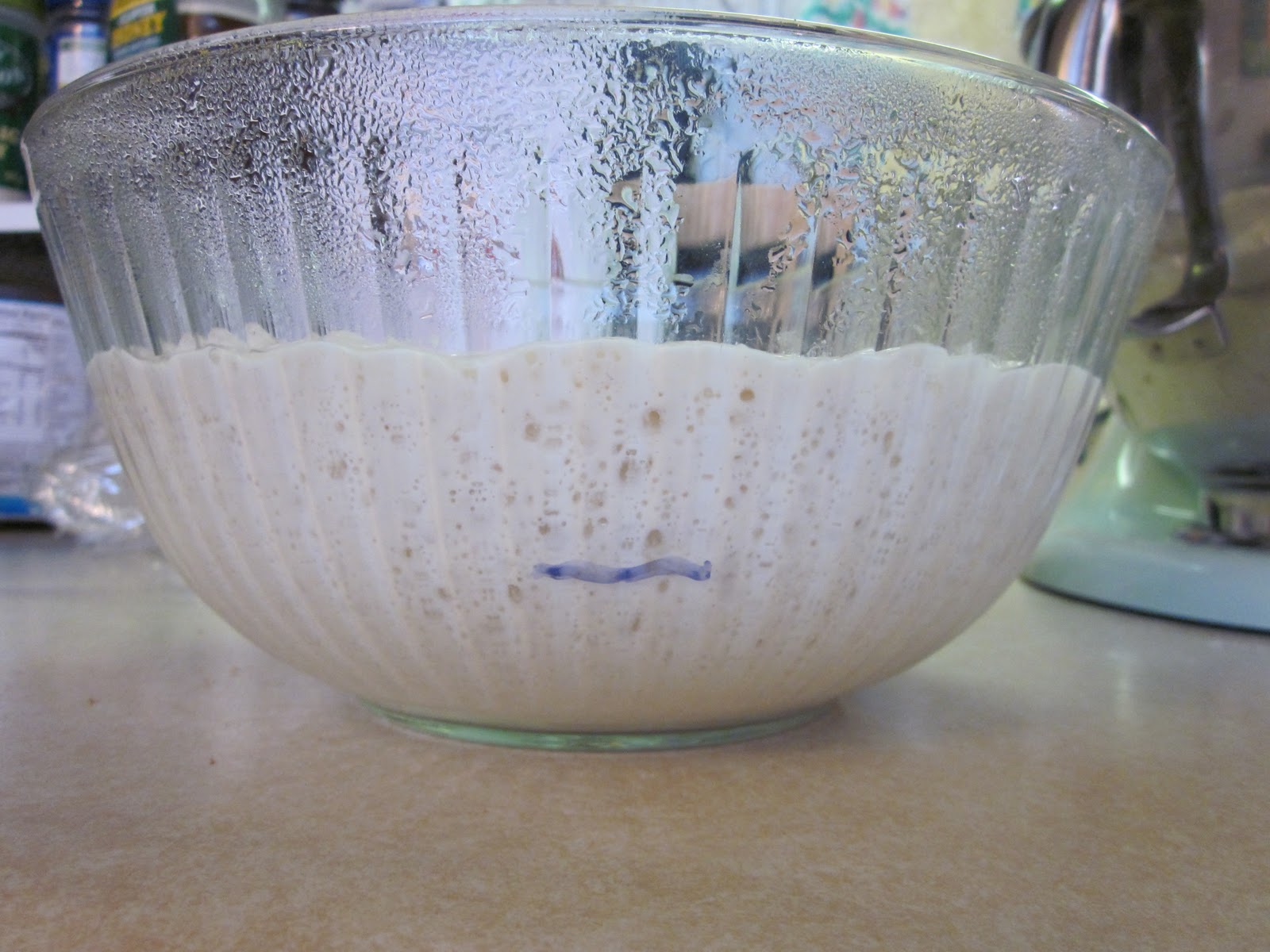
Make a pooling: Mix 1-1/2 cups warm water with 2 cups flour. Next add two teaspoons of active dry yeast, mixing until very smooth like pancake batter. Cover and let sit for about 30 minutes or until doubled in size as shown below.
Add 1/2 cup skim milk and 3 Tbs melted butter, mix. Add 3-1/2 cups flour 1/2 cup at a time while mixing. Knead with dough hook on speed two for 3 minutes. Cover and let sit at room temperature for 15 minutes to autolyse. Add 2 tsp of salt and knead at speed two for 3 minutes.
Put in greased bowl turning dough ball to coat. Cover and let rise until double about 35 minutes as shown below.
Note, this was originally posted here.
Posted by Matt & Katie
Experiment 2 had more butter than the basic recipe called for and we also worked in some olive oil as we kneaded the bread. Half of the batch this time went to make a loaf of cinnamon bread that turned out excellent (we made awesome french toast with it). The other half didn't rise to it's full potential and ended up being a little dense.
Since that time I have come to read about bread science online and have decided to take on a more rigorous approach in our bread experiments. For example see this excellent excerpt on bread chemistry, this fine tutorial on artisan breads, and this pizza fanatics blog.
Experiment 3
Make a pooling: Mix 1-1/2 cups warm water with 2 cups flour. Next add two teaspoons of active dry yeast, mixing until very smooth like pancake batter. Cover and let sit for about 30 minutes or until doubled in size as shown below.
Add 1/2 cup skim milk and 3 Tbs melted butter, mix. Add 3-1/2 cups flour 1/2 cup at a time while mixing. Knead with dough hook on speed two for 3 minutes. Cover and let sit at room temperature for 15 minutes to autolyse. Add 2 tsp of salt and knead at speed two for 3 minutes.
Put in greased bowl turning dough ball to coat. Cover and let rise until double about 35 minutes as shown below.
Punch down by gently pressing the dough. Knead 3 or 4 times. Separate dough into 2 pieces, one for cinnamon load and one for regular loaf. Notice the large air bubbles in the cut dough.
Knead each half 3 or 4 times and shape into a loaf. Place in greased pan, cover, and let rise until double in size about and hour. Bake at 375 for 28 minutes. The crust didn't turn out as dark as we wanted so it might be better to bake the loaves at a higher temperature or for a few minutes longer.
Notice the crumb. The air holes are slightly larger and more irregular in size... this is good, or rather better.
Posted by Matt & Katie
Subscribe to:
Comments (Atom)